
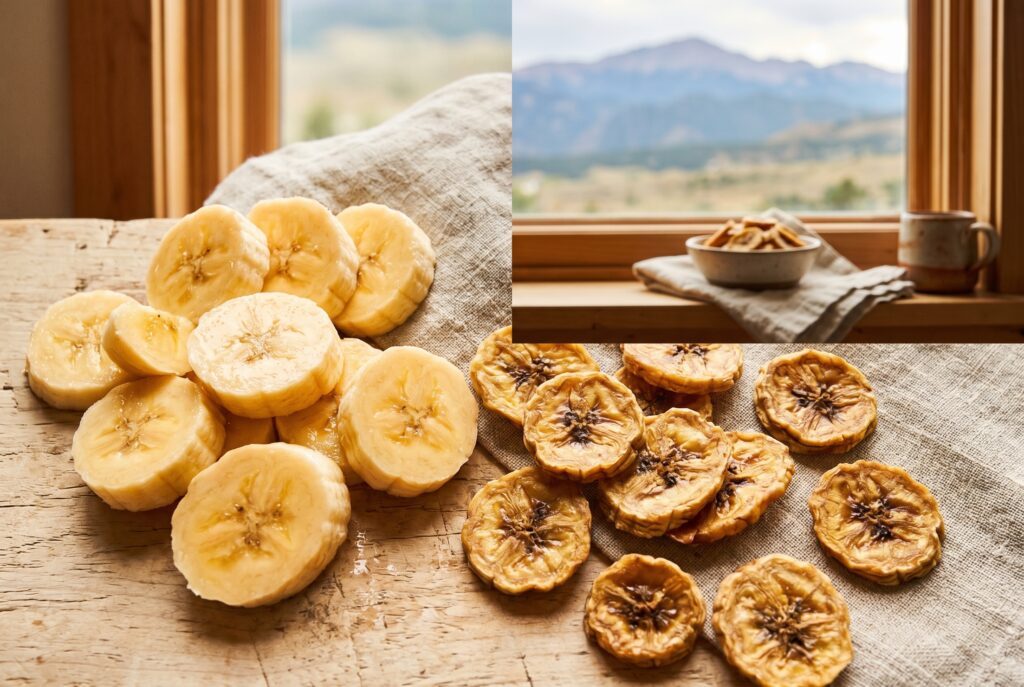
Are Dried Bananas Good for You? The Science Behind the Hiking Trail’s Favorite Snack
Here’s the uncomfortable truth: dried bananas are one of the most misleading snacks in the outdoor food aisle. They look innocent. They taste like banana. They come in resealable bags with pictures of mountains on them. And they deliver more concentrated sugar per bite than almost any whole fruit you’d pick at the grocery store.
Whether dried bananas are good for you depends entirely on what you’re eating them for — and how much.
The Potassium Argument: Why Bananas Matter
Let’s start with the case FOR bananas, dried or otherwise. A medium fresh banana delivers roughly 420 mg of potassium — about 9% of the daily recommended intake. Potassium matters for blood pressure regulation, muscle function, and nerve signaling. For active people — hikers, runners, cyclists — the electrolyte balance that potassium supports is genuinely relevant, especially at altitude.
Colorado sits at 5,280 feet minimum. Many residents train, hike, and run at considerably higher elevations. At altitude, potassium losses through respiration and sweat increase. A banana — fresh or dried — is a legitimate electrolyte source, not just a sugar hit. That matters.
But here’s the catch: a serving of dried banana slices (about 40 grams) contains roughly 3.5 fresh bananas’ worth of fruit. That’s not a bad thing if you’re burning calories. It’s a significant problem if you’re snacking at your desk.
The Sugar Density Problem
Fresh bananas contain approximately 14 grams of sugar per 100 grams of weight. Dried bananas? Somewhere between 60 and 80 grams of sugar per 100 grams, depending on the product and whether any sugar is added in processing. The dehydration process removes water, concentrating everything — fiber and micronutrients on one side, sugar on the other.
This isn’t a failure of the banana. It’s math. When you remove water from fruit, you don’t remove the sugar — you concentrate it into a smaller package that weighs less and sits in your pantry for months.
The American Heart Association recommends limiting added sugars to about 36 grams per day for men and 25 grams for women. A single 40-gram serving of dried banana chips can account for half of that — before you’ve eaten anything else. Add sugar-coated varieties and the number climbs further.
“The dehydration process removes water, concentrating everything — fiber and micronutrients on one side, sugar on the other. When a food product’s single-serving bag contains half your daily added sugar limit, that’s not a health food. That’s a candy bar that happens to contain potassium.”
Fiber and Micronutrients: What Survives Dehydration
Dried bananas do retain meaningful amounts of fiber — particularly insoluble fiber, which supports gut motility. A 40-gram serving of dried banana provides roughly 3–4 grams of fiber, comparable to a fresh banana in absolute terms, though the concentration is higher per gram.
Micronutrients hold up reasonably well through dehydration. Vitamin B6, which bananas are known for, survives the drying process with minimal loss. Iron content is preserved. Magnesium is retained. The potassium density — often cited as the primary reason to eat bananas — concentrates right alongside the sugar.
The issues arise with added ingredients. Many commercial dried banana products — particularly banana chips fried in oil — add sodium, saturated fat, and additional sugar or syrup coatings. Read the label. A product described simply as “dried bananas” with no other ingredients is a different food than “banana chips (fried in palm oil, sugar-coated).” The difference is substantial.
The Colorado Active Lifestyle Angle
For trail runners and hikers in Colorado’s Front Range, dried bananas serve a specific functional purpose: they’re lightweight, shelf-stable, calorie-dense, and easy to pack. On a 15-mile ridge run above Boulder, a 40-gram packet of dried banana delivers 130–150 calories of fast-digesting carbohydrates. That’s useful fuel during extended endurance activity.
For someone working at a desk, the same packet delivers 130–150 calories of fast-digesting sugar with no fiber to slow absorption — followed by a blood sugar spike and a crash an hour later.
The same product. Same ingredient. Different context, different outcome.
Colorado’s winters present another consideration. During ski season, appetite often drops while energy expenditure stays high or increases. The concentrated calories in dried fruit can help fill the gap without requiring large volume intake. This is legitimate. But it’s also true of nuts, seeds, and whole fruits — with less sugar density per serving.
The Bottom Line: When Dried Bananas Make Sense
Here’s my clinical take:
- During extended endurance activity (trail running, multi-hour hiking, backcountry skiing): dried banana slices are a reasonable fast-carb option. The potassium is genuinely useful, and the calories are efficiently delivered. Choose products with no added sugar or coatings.
- As a daily desk snack: this is where the argument collapses. The sugar density is too high, the portion control is too easy to lose, and the blood sugar impact is closer to candy than to nutrition. If you’re eating dried bananas at your desk, measure the portion.
- For people managing blood sugar: dried bananas are a high-Glycemic food that requires caution. The concentrated sugar hits fast. Fresh banana or banana with nut butter is a better choice for sustained energy.
- As a potassium source for active people: a fresh banana is cheaper, lower in sugar density, and easier to portion. Save dried bananas for when you genuinely need the weight and calorie advantage on the trail.
What to Look For
If you’re buying dried bananas — for the trail or otherwise — the label tells you everything:
- Single ingredient (“dried bananas,” “banana slices”) is the baseline. No sugar added, no oil, no sulfites.
- Unsulfured varieties preserve color better and avoid a less-common but real sulfur sensitivity issue.
- No added sugar or corn syrup: some products add these to improve taste and weight. Check the ingredient list.
- Banana chips fried in oil: these are a different product — higher in fat, often with added salt. Fine as a trail food, not ideal as a daily snack.
Shop Banana Products at Clinical Nutrition Center
Looking for convenient, portion-controlled banana-flavored snacks that fit a medical weight loss or active lifestyle plan? Clinical Nutrition Center carries options formulated for people managing their nutrition carefully.
The Takeaway
Dried bananas are not inherently bad. They’re context-dependent. For a trail runner burning 3,000 calories on a long day in the mountains, a banana chips packet is efficient fuel. For a person managing their weight or blood sugar in an office environment, it’s a sugar delivery mechanism with a health halo.
Know what you’re eating. Know why you’re eating it. And read the label — because “dried banana” on the front and “added sugar, corn syrup, sulfites” on the back describe two different foods wearing the same packaging.
Clinical Nutrition Center — 5995 Greenwood Plaza Blvd #150, Greenwood Village, CO 80111
Call: (303) 750-9454
This article is for informational purposes only and does not constitute medical advice. Individual nutritional needs vary. Consult with your healthcare provider before making significant dietary changes, particularly if you have diabetes, prediabetes, or other metabolic conditions.
